Project HydraFusion: Frontier quality via multi-model orchestration
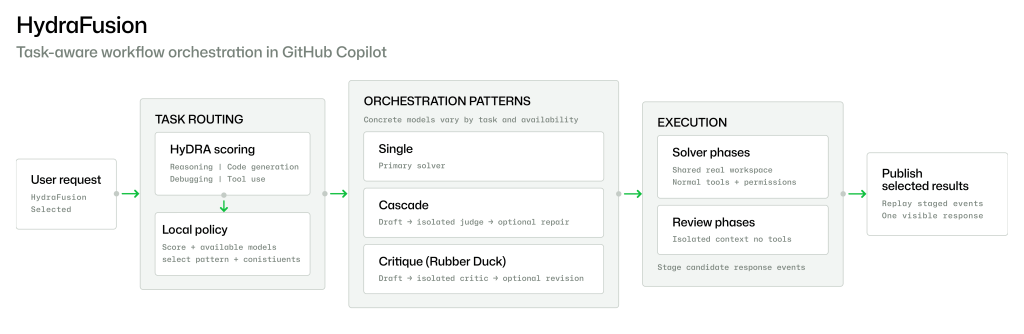
There is a persistent myth in software engineering that the single most powerful model is the only path to production-grade code. We have spent years racing toward ever-larger parameters, convinced that scaling raw intelligence is the solution to our productivity bottlenecks. But what if the answer lies not in building a bigger brain, but in orchestrating a smarter team? The release of Project HydraFusion challenges this singular focus, introducing a multi-model orchestration approach that prioritizes context and efficiency over brute-force computation.
In the high-stakes arena of code generation, the gap between experimental prototypes and reliable engineering tools has always been wide. We saw this clearly when the latest baseline models, like Opus 5, dominated controlled offline evaluations. They were impressive, undeniably capable, yet they carried a hidden tax: the estimated cost of running such massive models for every line of code is prohibitive for large-scale development workflows. This creates a paradox where the best tool is often too expensive to use consistently, leaving teams to toggle between quality and budget.
HydraFusion breaks this deadlock by acting as a sophisticated conductor rather than a soloist. Instead of blindly querying the most powerful model for every task, the system intelligently evaluates the complexity of the request. It determines whether a smaller, faster model can handle the job with sufficient accuracy or if the nuances of the code require the heavy artillery of a frontier model. This selective coding workflow is not merely a patch; it is a fundamental shift in how we approach the generation pipeline, ensuring that resources are allocated precisely where they are needed most.
The results of this orchestration are striking when viewed through the lens of real-world utility. In rigorous controlled evaluations, HydraFusion matched or even exceeded the performance benchmarks of the Opus 5 baseline. This is the holy grail of LLM application: achieving frontier quality without the frontier price tag. By filtering out unnecessary overhead, the system reduces the estimated workflow cost significantly, making it viable for organizations that need to integrate advanced AI into their daily dev cycles without exploding their infrastructure bills.
This matters deeply because the future of software development is not about waiting for magic models to emerge; it is about building systems that can adapt to the specific demands of the code they are writing. We are moving toward an era where the intelligence of the system comes from its architecture as much as its underlying weights. HydraFusion proves that we can maintain the highest standards of code quality while simultaneously optimizing for cost and speed, offering a sustainable path forward for the entire engineering community.
Now available as a research preview in GitHub Copilot, this technology invites developers to step out of the traditional linear workflow. It is a reminder that the most effective tools are often the ones that think for us, deciding which problems deserve deep analysis and which can be solved with agile, lightweight interventions. As we look toward the next frontier of coding assistants, the lesson from HydraFusion is clear: true progress comes from smart orchestration, not just raw power.