Superbubble in the Large Magellanic Cloud
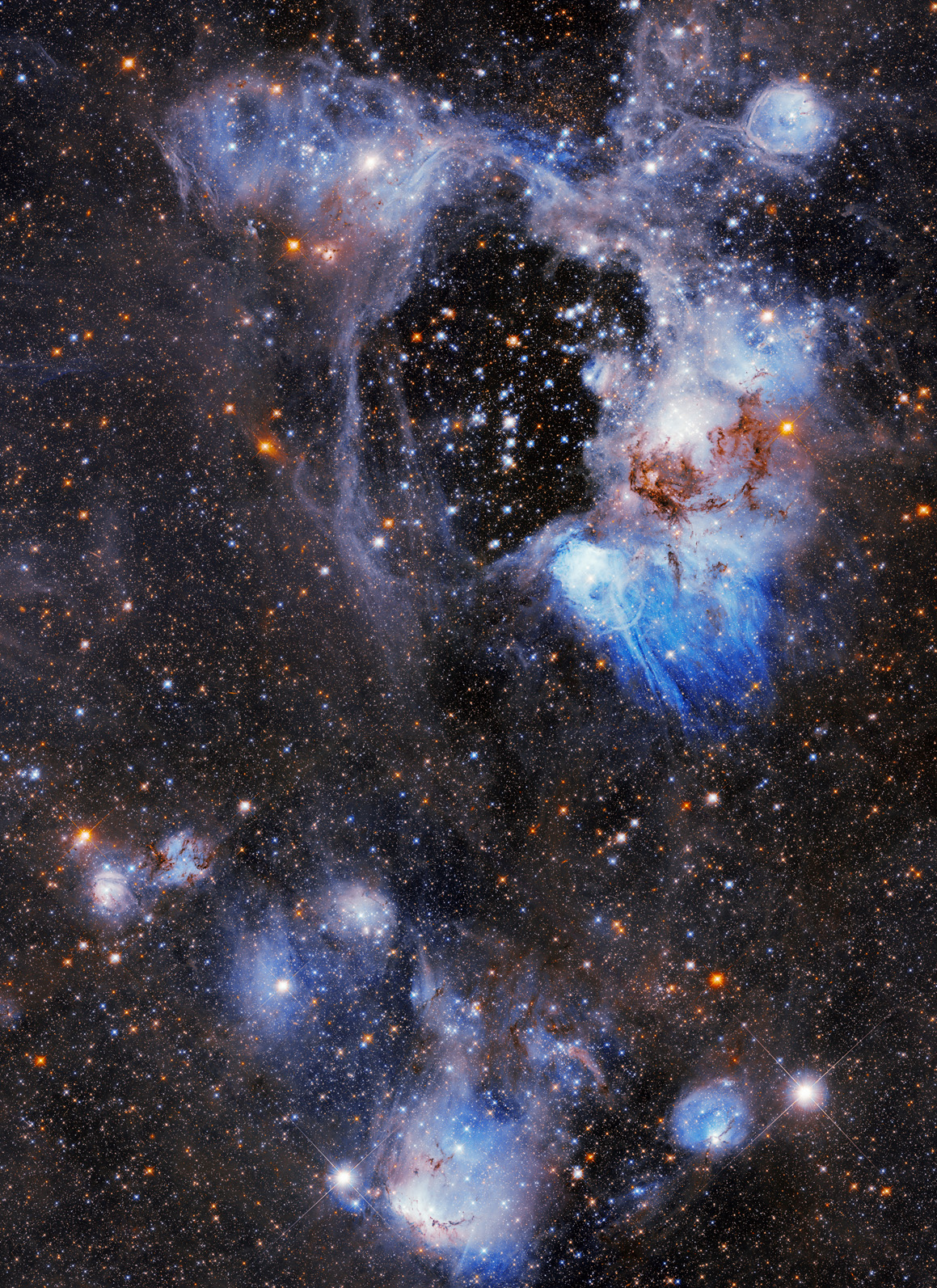
In the vast, velvet expanse of the cosmos, where silence is the only constant, there exists a region that defies the quietude with a roar of stellar violence. Nestled within the Large Magellanic Cloud, a satellite galaxy clinging to the edge of our own Milky Way's gravitational embrace, lies N44. It is not merely a nebula in the traditional sense of a gentle cloud of gas; it is a chaotic, high-energy laboratory where the laws of physics are pushed to their breaking points by the sheer weight of existence. Here, glowing hydrogen gas and dark lanes of dust weave a complex tapestry, masking and revealing massive stars that burn with a ferocity invisible from Earth.
At the heart of this celestial drama lies a feature so striking it demands a second look: a dark, starry gap known as a superbubble. Unlike the empty voids often depicted in science fiction, this gap is a testament to active creation. It is not a place where nothing exists, but rather a region where the density of stars is so profound that they outshine the surrounding gas, creating a silhouette against the backdrop of the universe. Visible in the upper central region of Hubble Space Telescope imagery, this bubble appears as a hollowed-out sphere, a scar left behind by the relentless winds of the most massive stars ever discovered.
These stars are not ordinary suns; they are behemoths, burning through their fuel reserves at an alarming rate. As they push gas and dust outward at supersonic speeds, they carve out this cavernous void, clearing a path through the interstellar medium. The superbubble is essentially a cavity blown by stellar winds, a dynamic process that shapes the galaxy's environment on a scale that dwarfs human comprehension. Within this cavity, the stars are so densely packed that they form a glittering core, a counter-intuitive phenomenon where darkness serves as the frame for an explosion of light.
Understanding this structure is crucial for astrophysicists because it reveals how galaxies evolve over billions of years. The superbubble in N44 is a snapshot of a galaxy in transition, showing us how massive stars influence their surroundings and how energy is redistributed across cosmic distances. It challenges our understanding of stellar feedback, the mechanism by which stars regulate the formation of new stars and the chemistry of the universe. Without these violent events, galaxies might remain static, lacking the intricate structures and diverse populations of stars that we observe today.
The image captured by Hubble does more than just record light; it tells a story of time and transformation. Each pixel in the photograph represents a complex interplay of gravity, pressure, and radiation, frozen in an instant that has taken millions of years to unfold. As we gaze upon this dark, starry gap, we are witnessing the aftermath of a cosmic battle, a remnant of the struggle between the crushing force of gravity and the expansive power of stellar radiation. It is a reminder that the universe is not a cold, dead place, but a dynamic, living system in constant flux.
Ultimately, the superbubble in N44 serves as a beacon of cosmic activity, illuminating the profound connection between the smallest particles and the largest structures. It reminds us that the beauty of the universe often hides behind the most daunting and destructive forces. By studying this phenomenon, we gain insight into our own origins, tracing the lineage of the atoms in our bodies back to the furnaces of these ancient, glowing giants. In the end, the dark gap is not empty; it is full of the history of the cosmos, waiting for us to decode its silent narrative.