The Funnest Drone to Fly, With One Big Image-Quality Catch
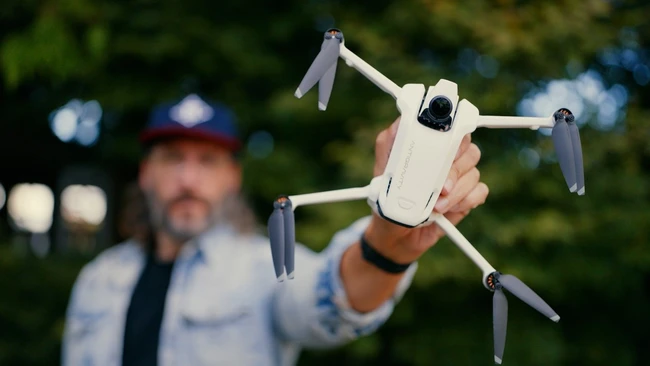
There is a profound, almost meditative state in flying a drone where the pilot is no longer wrestling with the vehicle to keep it upright, but is instead guiding it with the same fluidity one might use to steer a car or a bicycle. This shift happens when the camera and the flight path are perfectly synchronized, a concept realized in the Antigra by attaching a 360-degree camera directly to a 249-gram frame. For years, the industry has been obsessed with gimbal stabilization, treating the camera as a separate, heavy entity that requires constant counter-movement. The result is often a pilot who is hyper-aware of their own controls, fighting the wind and the weight of the sensor simultaneously. The Antigra changes the equation by making the camera the center of gravity, not an appendage fighting against it.
When you bolt a 360 unit to a lightweight drone, the physics of the flight change dramatically. The pilot stops fighting the camera because the camera is the drone. This single shift allows for a level of intuitive movement previously impossible in consumer aviation. You are no longer compensating for roll, pitch, and yaw; you are simply moving the object that captures the image. It feels less like piloting an aircraft and more like walking through a landscape, with the world unfolding around you in real-time. This is particularly liberating for creative pilots who have been held back by the technical hurdle of stabilizing shots while navigating complex terrain. The barrier to entry for high-quality, dynamic footage drops precipitously because the machine itself does the heavy lifting of stabilization.
However, this liberation comes with a significant caveat that cannot be ignored: image quality. The trade-off for this unprecedented ease of flight is the resolution and dynamic range of the capture. While the 360 cameras capable of this form factor have improved exponentially, they still cannot match the sensor size, lens quality, or color depth of a dedicated cinema drone like an Mavic 3 or an Inspire. The image is often grainier, with lower bit depth and a narrower dynamic range, which means it is not immediately suitable for professional broadcast without heavy post-production work. It forces a different kind of storytelling, one that embraces the raw, slightly imperfect texture of the moment rather than the polished, cinematic sheen of traditional aerial videography.
This limitation is not necessarily a flaw, but rather a constraint that defines the medium. By accepting the quality compromise, the pilot gains something more valuable: the ability to capture moments that would otherwise be lost. You can dive into a crowd, hover inside a forest canopy, or swoop between architectural details without worrying about crashing a multi-thousand-dollar rig or losing your grip on the controls. The technology democratizes the perspective, allowing anyone with a basic understanding of flight to create immersive content. It turns the drone from a precision instrument into a playful extension of the human body, prioritizing the experience of the flight over the pristine perfection of the final image.
Ultimately, the Antigra represents a pivotal moment in the evolution of aerial cinematography. It acknowledges that for many creators, the thrill of flight and the perspective of the 360 view are more important than the technical specs of the sensor. It challenges the notion that better images always require heavier, more complex machinery. By merging the pilot and the payload into a single, balanced unit, it redefines what is possible in the sky, proving that sometimes the most powerful tool is the one that lets you stop fighting and start flying.