Project HydraFusion: Frontier quality via multi-model orchestration
There is a persistent tension in modern software development between the holy grail of frontier intelligence and the cold, hard reality of operational cost. For years, the industry has treated large language models as either binary commodities—too small to be useful or too expensive to run at scale—or as magical black boxes where quality is the only metric that matters. We have accepted a world where generating code requires firing the most powerful models available, regardless of whether they are needed for a simple utility function. This approach is not just inefficient; it is a structural flaw that inflates budgets and slows down the velocity of innovation.
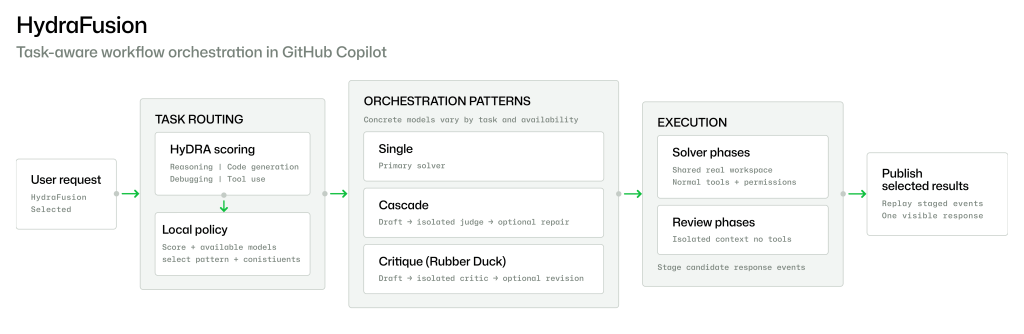
Enter Project HydraFusion, a new orchestration strategy that fundamentally rethinks this trade-off. Rather than relying on a single monolithic model to handle every task, HydraFusion introduces a selective workflow that intelligently routes coding requests based on complexity and context. The core insight is that not every line of code requires frontier-level reasoning. By deploying a hierarchy of models, the system can reserve the most expensive, high-capacity instances for the critical architectural decisions while letting smaller, faster models handle the routine glue code and boilerplate.
In controlled offline evaluations, the results were nothing short of disruptive. HydraFusion matched or even exceeded the performance of the Opus 5 baseline, a model representing the current ceiling of generative coding capabilities. Yet, the story does not end at quality metrics; the true breakthrough lies in the estimated workflow cost. By avoiding the over-application of massive models to trivial tasks, the system significantly reduced the resources consumed without sacrificing the fidelity of the output. It proves that you do not need to throw a sledgehammer at a nail to get the job done, even when the alternative is a hammer that can split atoms.
The mechanics behind this success lie in the sophistication of the routing logic. The system does not make static choices; it analyzes the semantic weight of the request in real-time, considering factors like codebase context, intent ambiguity, and expected complexity. When a request is deemed complex enough to warrant top-tier attention, the model is engaged. When the task is straightforward, a lighter model takes the wheel. This dynamic adjustment creates a fluid environment where the right tool is always present for the right moment, effectively eliminating the waste that has long plagued enterprise AI adoption.
This shift represents a crucial maturation phase for developer tools. We are moving away from an era of blind optimism, where "bigger is better," toward an era of pragmatic optimization. For engineering teams, the implications are profound: they can now access frontier-quality assistance without the prohibitive overhead that often makes such tools a non-starter for everything except greenfield prototypes. It democratizes high-level code generation, making it viable for everything from a quick script to a massive microservices architecture.
Now available as a research preview in GitHub Copilot, HydraFusion invites developers to test these waters and witness the efficiency firsthand. It is a reminder that in the race to build the future, we must not forget the fundamentals of engineering efficiency. By orchestrating models rather than just deploying them, we unlock a new standard of value where quality and cost finally align, allowing teams to focus on building rather than burning through resources.