Is Time Even Real? Does It Even Flow?
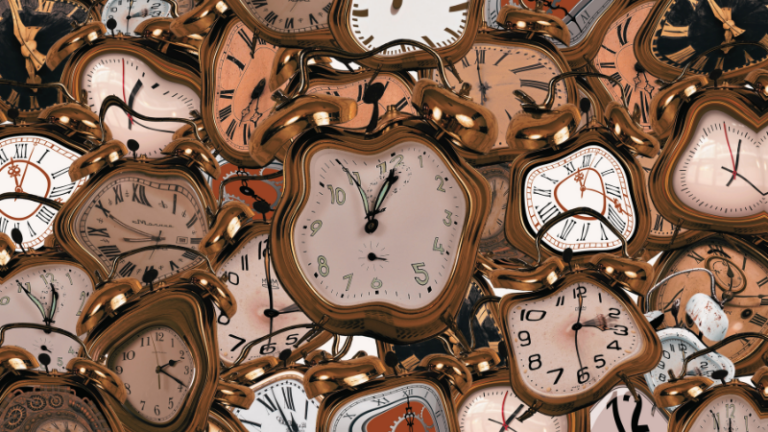
We often treat time as the invisible river that carries us from yesterday to tomorrow, a fundamental backdrop against which the drama of human life unfolds. It feels as solid as the ground beneath our feet or as vast as the sky above, yet if we peel back the layers of our intuition, we find that time may be less a thing that exists and more a trick our brains play to make sense of change. For centuries, philosophers and scientists alike have wrestled with whether time is a real dimension of the universe or merely a construct of human consciousness, a convenient fiction we invented to track the decay of things.
Albert Einstein shattered the comforting certainty of Newtonian physics by revealing that time is not a universal constant ticking away in perfect synchrony for everyone everywhere. Instead, time is malleable, stretching and contracting depending on how fast you move and how strong gravity is around you. This means that the "now" experienced by an astronaut orbiting a black hole could be years behind the "now" of someone sitting on Earth, proving that time is not a rigid container but a flexible fabric woven into the very structure of spacetime. If time can bend and warp, then its nature as a fundamental, flowing reality becomes deeply suspicious.
Beyond the physics, the thermodynamics of the universe offers a chilling perspective: time might be an illusion born of entropy, the relentless increase of disorder. The so-called "arrow of time"—why we remember the past and not the future—might simply be a statistical tendency toward chaos rather than a fundamental property of reality. In this view, the universe at a fundamental level might be timeless and static, with the sense of flow emerging only when we look at the macroscopic scale and see how energy disperses. This suggests that our profound sense of moving through an eternal present is a biological illusion, a narrative device evolved to help us survive by distinguishing threats from safety.
Consider the quantum realm, where particles exist in superpositions of states until they are measured, defying the linear progression of cause and effect that defines our classical experience. In these microscopic interactions, the distinction between past, present, and future blurs into a timeless equation, hinting that the flow we perceive is a macroscopic approximation of a deeper, static reality. If the building blocks of the universe do not care about sequence, then the relentless march of time we take for granted might be a large-scale emergent property, a shadow cast by more complex arrangements of timeless elements rather than a fundamental feature of existence itself.
Whether time is a real river or a phantom projection of our minds, the question forces us to confront the limits of our perception and the reliability of our most basic intuitions. We live our lives as if time is an enemy to be fought, a resource to be managed, or a path to be followed, but understanding that it might not exist in the way we think could fundamentally alter how we value the moments we have. It invites a shift from a frantic race against the clock to a contemplative awareness of the eternal stillness beneath the surface of our frantic, flowing lives.