APOD: 2026 September 7 – The Pelican Nebula in Gas, Dust, and Stars
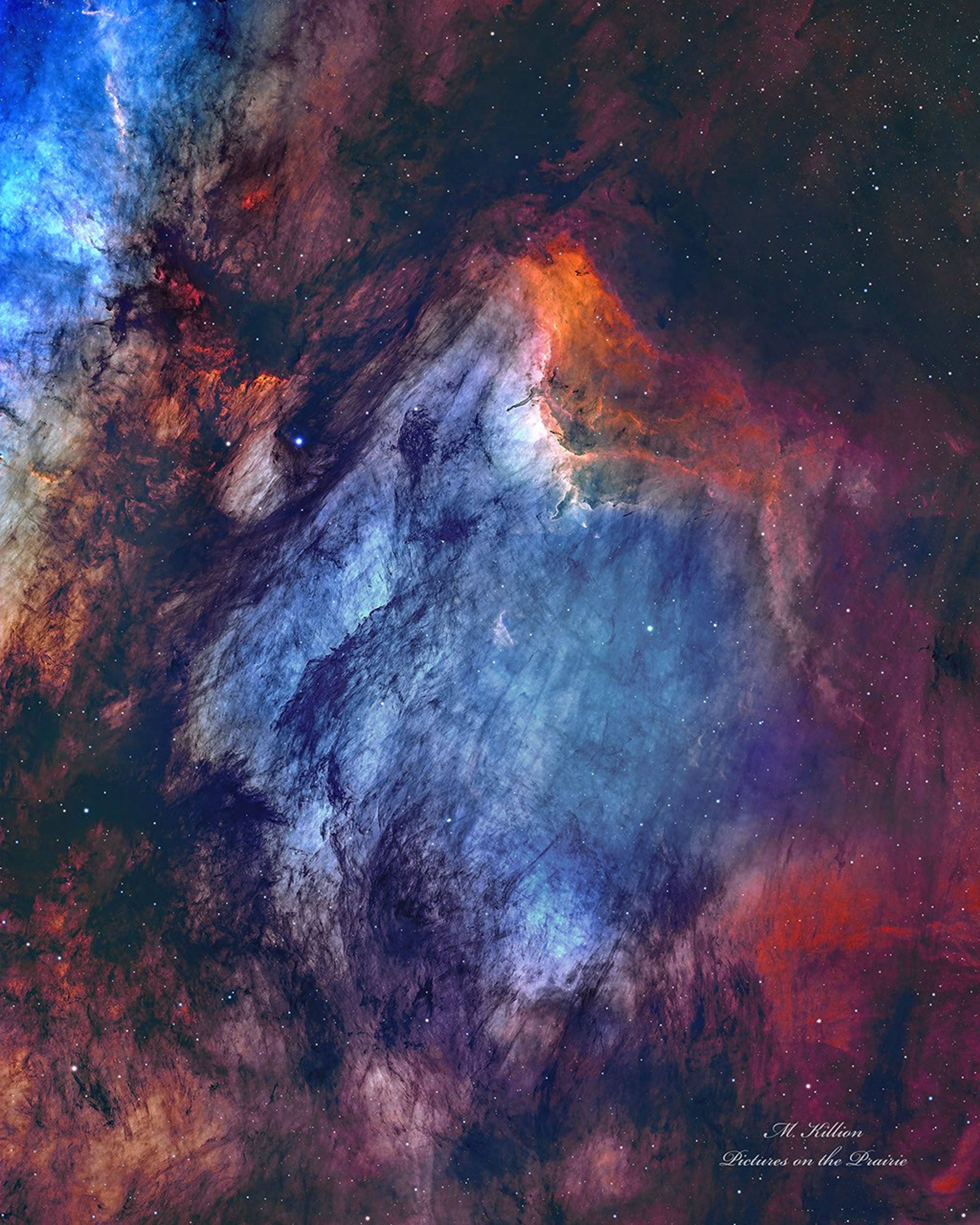
There are places in the universe where the chaos of creation is so intense that it looks like a storm trapped in space, and the Pelican Nebula is one of the most striking examples we have. Located just over ten thousand light-years away in the constellation Cygnus, this stellar nursery is a swirling masterpiece of gas and dust where newborn stars are just beginning to punch through their protective cocoons. The name itself, derived from its resemblance to a wading bird with a long beak and outstretched wings, serves as a poetic reminder that the cosmos often hides familiar shapes within its vast, alien expanse.
What makes this nebula particularly fascinating is the dynamic interplay between the stars forming within it and the stellar giants already present. At the heart of the structure lies the open star cluster Melotte 16, home to several massive, luminous stars known as O-type and B-type stars. These cosmic beacons burn with such ferocity that they emit intense ultraviolet radiation, carving out a hollow bubble in the surrounding molecular cloud. This process, known as photoevaporation, is the universe's way of sculpting the chaotic raw material of hydrogen and helium into the structured environments where life might eventually find a foothold.
The image captures a moment of violent beauty where dark, dense pillars of dust stand in stark contrast to the glowing blue and pink hues of ionized gas. These dark lanes are not empty voids but rather dense concentrations of material too thick to be illuminated by the nearby stars, serving as the future sites of new star formation. As the massive stars continue to erode the cloud, these pillars will either collapse under their own gravity to birth the next generation of stars or be completely evaporated, leaving behind a cavity that may host future generations of planetary systems.
Understanding the life cycle of a nebula like this is crucial for astronomers trying to piece together the history of our own solar system. We are essentially looking at a time capsule of what our own birth environment might have looked like hundreds of millions of years ago, only compressed into a much smaller and younger timeframe. The Pelican Nebula demonstrates that star formation is not a gentle, slow process but a frenetic, high-energy event driven by the feedback loops of stellar radiation and gravitational collapse.
To the naked eye, this region of space would appear as nothing more than a bright patch of sky, perhaps indistinguishable from the background glow of the Milky Way. Yet, through the lens of deep space observatories, it reveals a complex architecture of shock fronts, magnetic fields, and thermal currents that defies simple description. It is a testament to the power of technology and human curiosity, allowing us to witness processes that are happening light-years away in real time, bridging the gap between our quiet Earth and the roaring furnaces of the galaxy.