APOD: 2026 September 20 – Analemma over the Callanish Stones
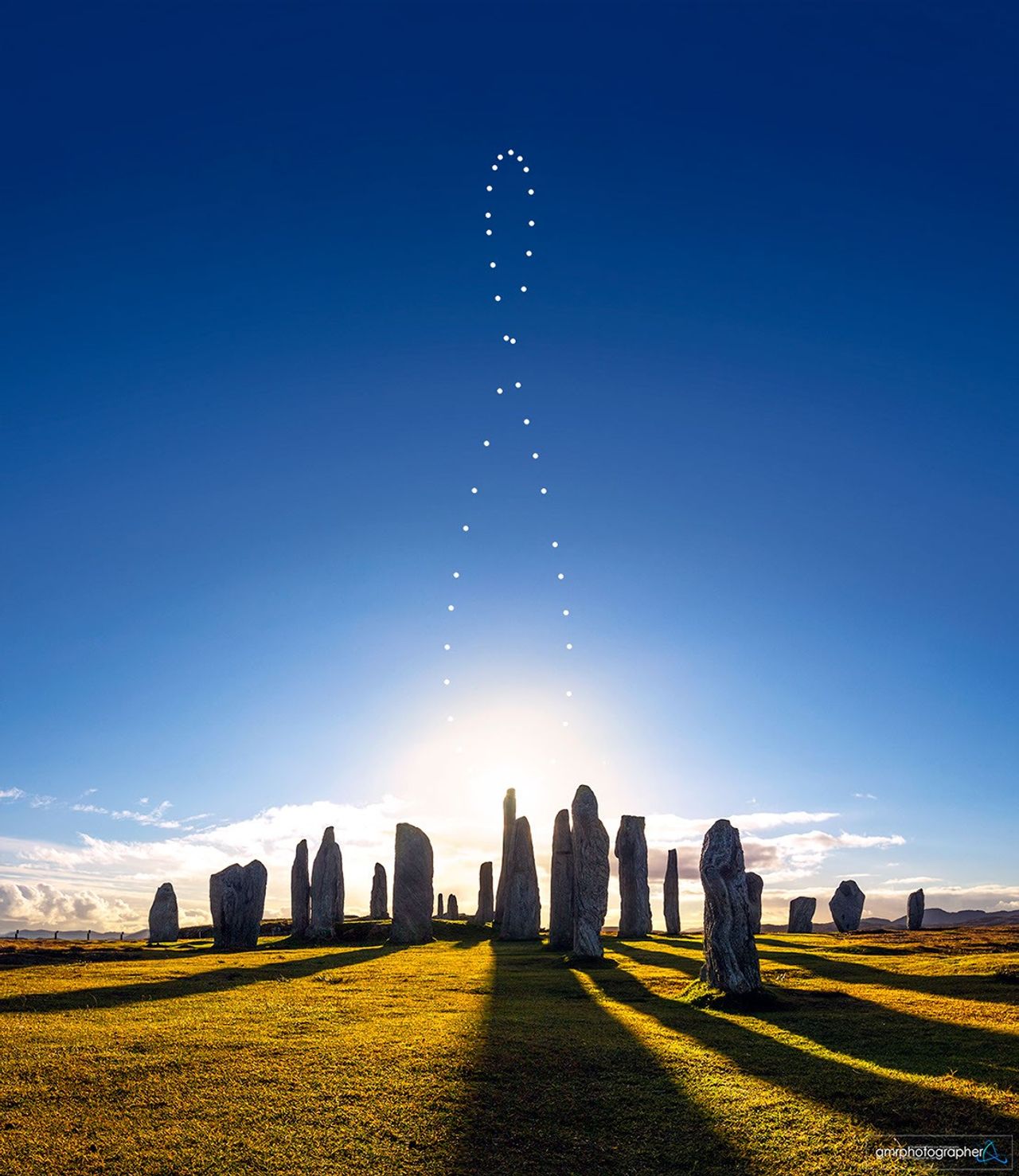
We often think of the sky as a chaotic canvas, painted anew by every setting sun and rising star, but there is a hidden rhythm beneath this apparent randomness. On September 20th of the year 2026, that rhythm becomes visible to the naked eye against the backdrop of the ancient Callanish Stones in Scotland. These standing stones, erected by a Neolithic civilization some six thousand years ago, are aligned with precision, yet they do more than mark the cardinal directions; they serve as a giant terrestrial sundial that captures the subtle wobble of our planet. When viewed from a specific vantage point, the position of the sun traces a figure-eight pattern over the course of a year, known as an analemma, and in 2026, this celestial knot hangs perfectly over the monolithic ruins.
To understand why this moment is so profound, one must appreciate the mechanics of Earth's dance. Our planet does not orbit the sun in a perfect circle, nor does it rotate on an axis that is perfectly upright; it tilts at an angle of about 23.5 degrees and moves in an elliptical path. These two factors combine to create the equation of time, causing the sun to appear in slightly different positions at the same clock time on different days. If you were to photograph the sun at exactly noon every single day for a full year, the resulting image would not show a single point, but rather this elegant, looping figure-eight. The Callanish Stones, with their vertical slabs and horizontal lintels, act as a natural frame for this phenomenon, grounding the abstract mathematics of orbital mechanics in a place where humans once looked up and saw the divine order of the cosmos.
The significance of the Callanish Stones themselves adds a layer of historical weight to this astronomical event. Carved from the local basalt and arranged in a complex layout, these structures are believed to have served as an observatory for tracking the movements of the sun, moon, and stars. For the people who built them, the sky was not a distant abstraction but a direct, immediate reality that dictated their seasons, their agriculture, and their rituals. To see the modern scientific concept of the analemma superimposed on their ancient alignment is to bridge the gap between the mystical intuition of our ancestors and the rigorous precision of contemporary astronomy. It suggests that the human desire to understand our place in the universe has not changed, even as our methods of observation have evolved from stone cairns to space telescopes.
As the years pass, the position of the analemma shifts slightly, moving along a slow trajectory across the sky. By September 20th in 2026, the sun will appear in a specific spot within that figure-eight, a spot that will look different a year later and a year before. This impermanence is what makes the sky so hauntingly beautiful; no two sunrises are ever exactly the same, not even when viewed from the exact same location at the exact same hour. The image we capture on this specific day is a fleeting snapshot of a continuous motion, a still frame from a movie that plays out over a lifetime. It serves as a reminder that while the stones will stand for another thousand years, our view of them through the lens of time is constantly changing.
There is a profound humility required when witnessing such a scene. We stand as temporary observers in a vast, rotating system, watching a celestial knot form above the silent guardians of the past. The Callanish Stones have weathered millennia of storms and human history, and now they witness this daily dance of the sun once again. It is a moment that connects the microscopic tick of a clock with the macroscopic sweep of planetary orbits, reminding us that we are part of a grand, unfolding story that has no beginning and no end. In the silence of the Scottish highlands, under the watchful gaze of the stones, the universe reveals its intricate design, waiting only for someone to look up and see it.
On Bluesky? Meet HomeSky.
Follower analytics, a growth toolkit, scheduling and AI posting — built for Bluesky. Connect your account and use everything free for 60 days.
Try HomeSky free →