APOD: 2026 September 19 – A Zodiacal Night
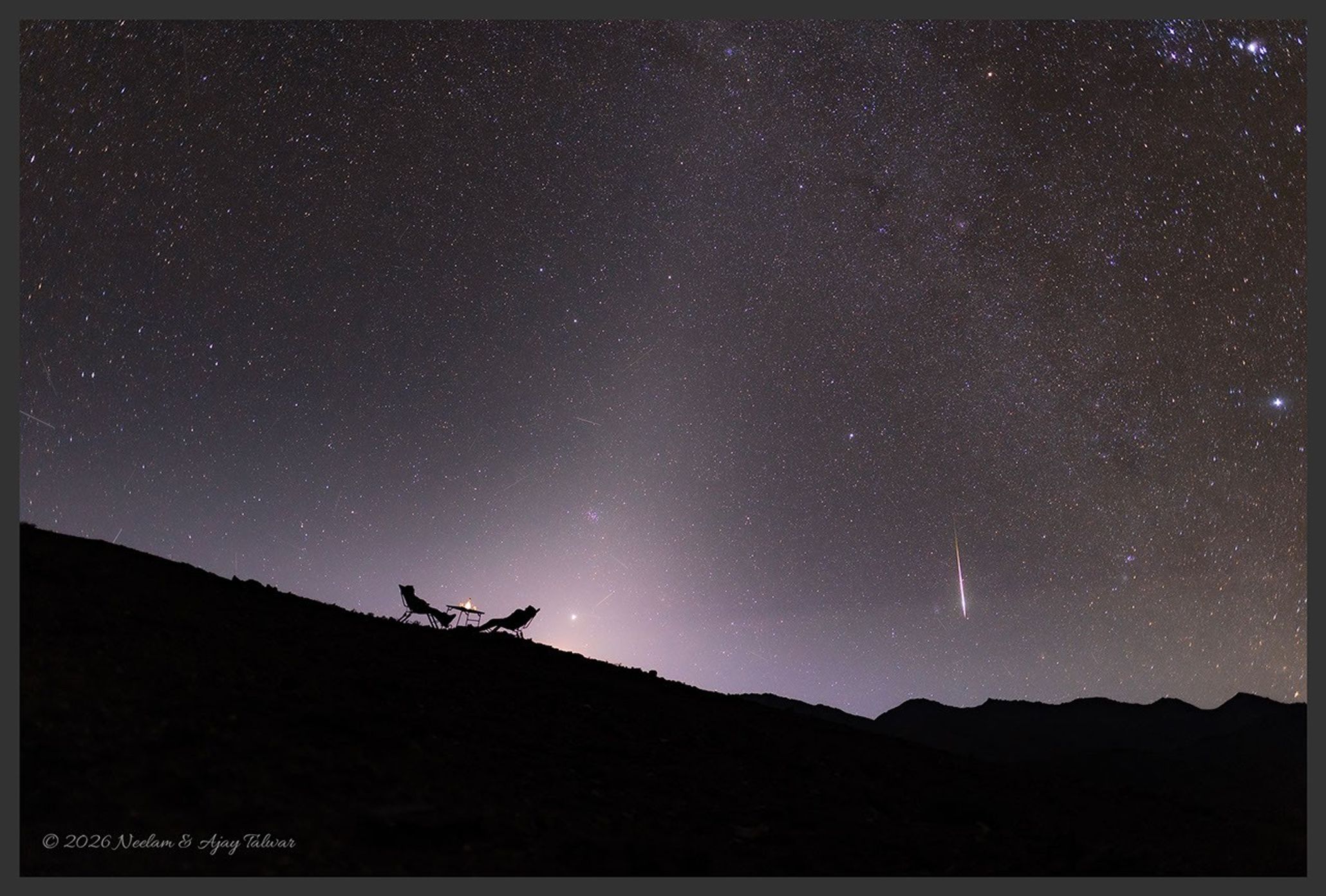
We often look up at the night sky expecting to see distinct points of light or streaks of fire, yet the true canvas of the universe is frequently washed in a soft, silent glow that is invisible to the unaided eye. This September night, the sky offered not a star, but a subtle luminous tapestry known as the zodiacal light, a phenomenon that reminds us how crowded our solar neighborhood really is. It is a ghostly cone of dawn light that stretches from the horizon toward the zenith, a visual testament to the sheer volume of dust that surrounds us, lingering from the debris of our own formation.
This ethereal glow is not the light of stars or distant galaxies, but the reflection of the Sun dancing off a vast cloud of interplanetary dust grains. These tiny particles, ranging from the size of a grain of sand to a speck of dust, orbit the Sun within the ecliptic plane, the same flat disk where the planets wander. As sunlight strikes them, it is scattered back into space, creating a faint, milky pillar that is most visible when the sky is perfectly dark and the observer has the patience to stare. It is a quiet spectacle, requiring no telescope, yet demanding a darkness and a horizon unobstructed by city lights or mountains.
The visibility of this phenomenon is a race against time and light pollution, a struggle that defines the experience of modern stargazing. To witness the zodiacal light, one must find a location far removed from the artificial glare of civilization, ideally facing away from the Sun's glare in the direction of the constellation where the ecliptic arches highest. On a clear night with a low horizon, the cone of light can rise several degrees above the horizon, resembling the tail of a celestial beast or the rays of a dawn that has not yet begun. It is a reminder that even in the void between the stars, we are bathed in the debris of our own history.
Beyond its aesthetic beauty, the zodiacal light holds profound scientific significance, serving as a window into the architecture of our solar system. By studying the intensity and polarization of this scattered light, astronomers can map the density and distribution of dust throughout the inner solar system. These dust clouds are not static; they are a dynamic mix of material shed by comets and asteroids, constantly evolving as the Sun's gravity and solar wind interact with the debris. Observing this light allows us to understand the birth of our own system and the processes that continue to shape it today.
There is a humbling philosophy embedded in this nightly apparition, a concept that Carl Sagan might find deeply resonant. We often feel small in the face of the infinite cosmos, yet this phenomenon proves that we are not isolated; we are embedded in a rich, dusty environment that connects us to every other planet and every comet that has ever passed. The zodiacal light is the visual imprint of our existence, a soft halo surrounding our home. To see it is to realize that the universe is not just empty space waiting to be filled, but a place teeming with the remnants of creation, silently illuminating the darkness for those willing to wait and look.
On Bluesky? Meet HomeSky.
Follower analytics, a growth toolkit, scheduling and AI posting — built for Bluesky. Connect your account and use everything free for 60 days.
Try HomeSky free →